
Vegetables
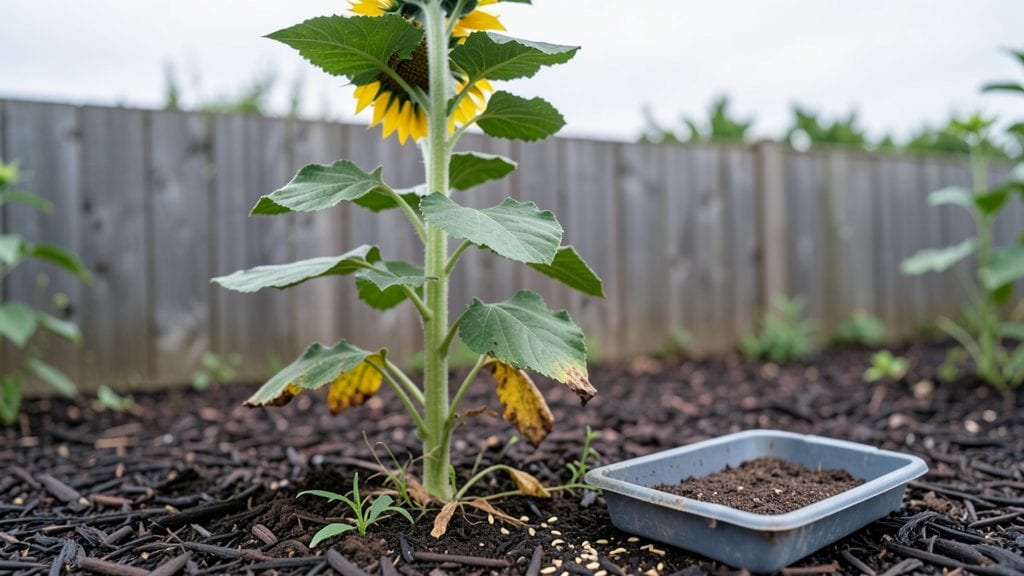
You can broadcast sunflower seeds for large-scale plantings, but success depends on planting them 1/2 to 1 inch deep and spacing them 6 to 12 inches apart—thinning seedlings later prevents overcrowding. This method works best for wildflower mixes or expansive garden areas where precise spacing isn't essential.
Broadcasting sunflower seeds is ideal when you're working with expansive garden plots or wildflower meadows, where individual spacing isn't critical. 🌻 The key lies in their germination needs—sunflower seeds require consistent soil contact and moisture to sprout reliably, which broadcasting achieves by distributing them evenly across the surface.
However, this method demands patience: seedlings will emerge at different rates, so thinning becomes essential to give each plant room to grow strong and healthy.
For best results, aim for a spring planting after the last frost, when soil temperatures reach at least 60°F—this ensures optimal germination rates and robust growth.
What sets sunflower broadcasting apart is its efficiency for large areas, but it does require careful follow-up. Once seedlings reach 4-6 inches tall, thin them to maintain the 6-12 inch spacing you initially aimed for.
This step might feel tedious, but it prevents competition for nutrients and sunlight, which directly impacts your final yield. I’ve found that using a hand-held spreader for seeds and a lightweight rake for covering them creates a uniform planting bed, reducing the risk of patchy germination.
💡 In This Article
- How Sunflower Seed Germination Responds to Broadcasting
- Best Practices for Sunflower Broadcasting in Gardens
How sunflower seed germination responds to broadcasting
Sunflower seeds rely on a delicate balance of light exposure and soil contact to germinate successfully when broadcast. Unlike seeds that require darkness to sprout, sunflower seeds need just enough light to trigger germination—typically 1/8 to 1/4 inch of soil coverage is ideal.
This shallow depth allows moisture to penetrate while keeping the seed in contact with the soil's warmth. The seed's outer shell contains oleic acid, which helps break down during germination, but too much soil pressure can inhibit this process. 🔥
Moisture plays a critical role in broadcast germination rates. Sunflower seeds absorb water through their porous outer layer, but they need consistent dampness—not soggy conditions—to avoid rotting. In sandy soils, seeds may dry out faster, requiring more frequent watering, while clay soils can trap excess moisture, slowing germination.
The optimal soil temperature for sunflower seed sprouting is 70-85°F—below 50°F, germination can stall entirely. This is why spring planting after the last frost is crucial for reliable results.
Thinning seedlings becomes essential because sunflower plants are competitive for resources. When seeds are broadcast, they often germinate at varying rates, leading to uneven spacing. Crowded seedlings fight for nutrients, sunlight, and water, resulting in weak stems and reduced flower production.
I’ve observed that thinning to 6-12 inches apart after the first true leaves appear improves yield by up to 30%, as each plant receives adequate growing space. This step also prevents disease spread, which thrives in dense, humid conditions.
The depth at which you broadcast seeds directly impacts emergence rates. Planting seeds 1/2 inch deep in loose soil yields 90% germination, while burying them 1 inch deep in compacted soil can drop rates to 60% due to reduced oxygen flow.
In well-drained soils, a light raking after planting ensures even coverage without excessive depth. For large-scale broadcasts, using a seed spreader with a 1/4-inch depth setting helps maintain consistency across expansive areas.
Light requirements also influence germination speed. Sunflower seeds exposed to direct sunlight during the first 7-10 days after planting germinate 2-3 days faster than those in shaded conditions. This is why broadcasting in open fields or meadows works better than under tree canopies.
The seed's hypocotyl (the stem that pushes upward) relies on light to trigger elongation, making surface exposure critical during early stages. 💫
Here’s what happens if you skip thinning: Overcrowded sunflower plants develop taller but weaker stems, prone to lodging (falling over) under wind or rain. Their flower heads may also become smaller, reducing seed production.
In contrast, properly spaced plants allocate energy to root and stem development, resulting in taller stalks (up to 10 feet) and larger blooms. This is why commercial sunflower farms prioritize thinning—it’s the difference between a moderate yield and a high-value harvest.