
Vegetables
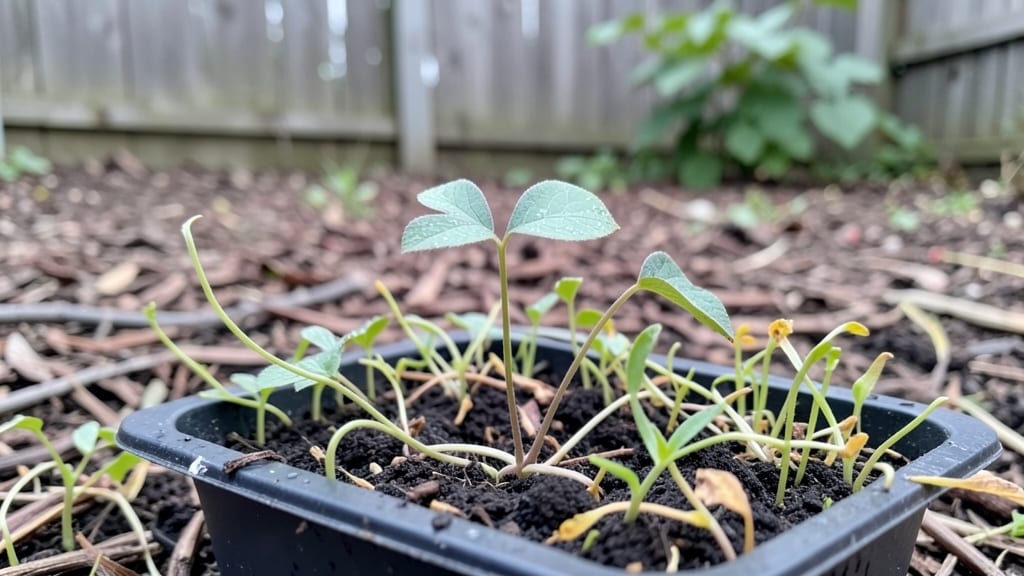
Identifying black bindweed seedlings starts with their arrowhead-shaped leaves featuring pointed lobes and a striking deep purple-black coloration, paired with slender, hairless stems that twist clockwise. These fast-growing plants set them apart from look-alikes like morning glory.
Black bindweed seedlings stand out in gardens thanks to their unique leaf morphology and growth habits. The heart-shaped leaflets with three pointed lobes create a distinct arrowhead pattern, while their clockwise-twisting stems help differentiate them from other vines.
These traits appear early in their development, making them easier to spot before they spread aggressively. 💫
What makes these seedlings particularly challenging is their rapid growth rate, which allows them to establish deep root systems quickly. Unlike morning glory, which has more rounded leaves and counterclockwise stem twists, black bindweed's purple-black foliage serves as a natural warning sign for gardeners.
The key to control lies in early identification—once you recognize these distinctive features, you can act before the vines become unmanageable.
💡 In This Article
- Distinguishing Black Bindweed Seedlings by Leaf Structure
- Field Guide for Black Bindweed Seedling Control
Distinguishing black bindweed seedlings by leaf structure
The arrowhead-shaped leaves of black bindweed seedlings are their most defining feature, with each leaflet exhibiting three distinct, sharp lobes that create a triangular outline. These lobes typically measure 1-2 centimeters wide at their base, with the central lobe extending slightly longer than the side lobes.
The leaflets attach to the stem via petioles that are about 1-1.5 centimeters long, creating a staggered pattern along the vine that's unique to this species. 🌿
What sets black bindweed apart visually is its deep purple-black pigmentation, which develops most intensely in full sunlight but may appear more muted in shaded areas.
Under a magnifying glass, you'll notice the leaves have a prominent central vein with secondary veins radiating outward at roughly 45-degree angles, forming a web-like pattern. This venation creates a textured appearance that contrasts with the smoother leaves of morning glory, which lack these pronounced secondary veins.
The clockwise twisting habit of black bindweed stems is another critical identifier, occurring because the plant's stem growth follows a dextral (right-handed) helical pattern. This twist happens at about one full rotation every 3-5 centimeters of stem growth, creating a distinctive corkscrew appearance.
Morning glory, by comparison, exhibits a counterclockwise twist, while field bindweed stems grow in a more linear fashion without pronounced twisting.
Light conditions dramatically affect seedling appearance: seedlings in direct sunlight develop the darkest pigmentation and most pronounced leaf structure, while those in partial shade may exhibit lighter green or reddish hues with less defined lobes. This variation is why identification is most reliable in sunny garden conditions.
The rapid growth rate—up to 6 inches per week under optimal conditions—means these traits become visible within just 2-3 weeks of germination. 🌱
Early identification is crucial because black bindweed's rhizomatous root system can spread horizontally up to 3 feet underground, making it nearly impossible to eradicate once established.
The heart-shaped leaflets with their three distinct lobes serve as an early warning system: when you see this pattern emerging from the soil, you're looking at a plant that will quickly dominate garden space if left unchecked.
For gardeners, understanding these leaf structures provides a visual checklist for identification: look for three-lobed arrowhead shapes, clockwise stem twists, and purple-black foliage in sunny areas.
These traits create a clear distinction from morning glory's rounded leaves and field bindweed's more elongated leaflets, helping you take action before the vines become unmanageable. 🔍